Every day, thousands of good domain names quietly expire. Most were registered years ago, used once, and forgotten. When the owner doesn't renew, the name doesn't vanish — it works its way through a fixed expiry lifecycle and, weeks later, drops back onto the open market for anyone to register. If you've ever wanted a name that's "taken" but clearly abandoned, drop-catching is how you get it.
This guide explains what happens when a domain expires, how drop-catching works, and — the part most people get wrong — when to register it yourself versus when you need a backorder.
What happens when a domain expires
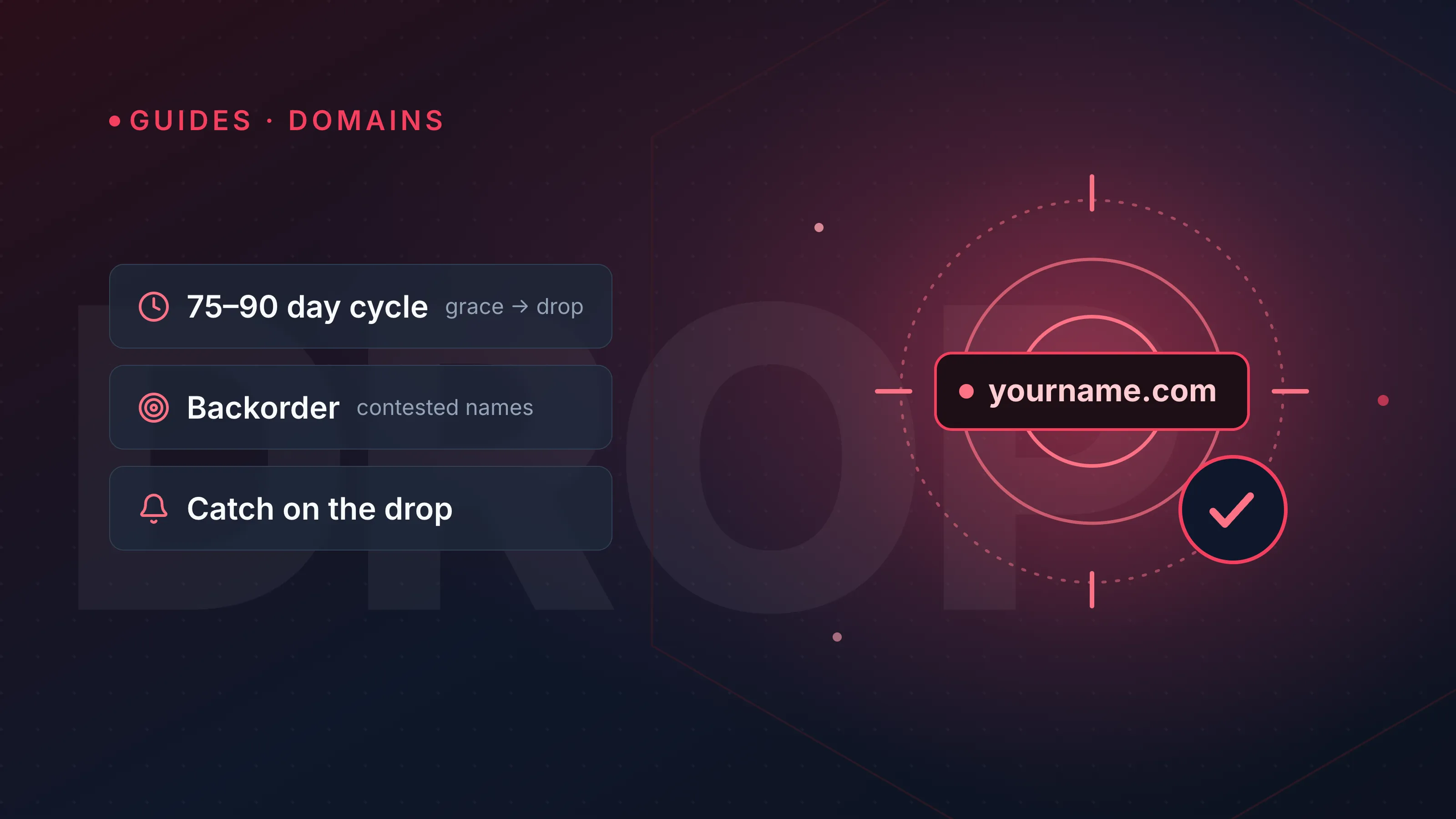
A domain doesn't become available the moment it expires. It moves through several registry-defined stages, and understanding them tells you when a name will actually drop:
- Active → expiration date. The registration lapses. Most registrars stop the domain resolving but keep it recoverable.
- Grace period (~0–45 days). The original owner can still renew at the normal price. Many "expired" names are renewed here — so a name sitting in grace is not a safe bet.
- Redemption period (~30 days). The name is clearly heading out, but the owner can still restore it by paying a steep redemption fee. Fewer names come back from here.
- Pending delete (~5 days). The decision is final — no one can renew or restore it now — and the registry is counting down to release.
- Drop. At the end of pending delete the registry deletes the name and it becomes available again, often for just a few seconds before someone grabs it.
The whole cycle typically runs 75–90 days for a .com, though it varies by TLD. The takeaway: a name is only really catchable once it reaches pending delete — everything before that is a maybe.
What is drop-catching?
Drop-catching (also called backordering) means registering a domain the instant it becomes available after expiring. Because a good name can be re-registered within seconds of dropping, catching it by hand is essentially impossible — you'd have to fire a registration at exactly the right millisecond. Instead, you set the catch up ahead of time and let software race the drop for you.
Is the name even worth it? Two questions first
Before chasing a name, separate two things people constantly conflate:
- Is it a good name? Length, extension, whether it's a real word, keyword value, brandability, age. A short
.comreal word is gold; a hyphenated eight-word.infois not. - Is it really being released? A great name the owner renews at the last minute is a waste of your time. Signals that a name is genuinely dropping include no active website or email, a parked or "for sale" page, an expired SSL certificate, and where it sits in the lifecycle above.
InfraNest scores both of these for every name you watch — a domain-quality score and a separate catchability score — each with the plain-English reasons behind it, so you spend effort on names you can actually get. See how drop-catching works in InfraNest.
The three ways to catch a name
Once a name is worth chasing, there are exactly three approaches — and picking the right one matters more than anything else.
Just alert me
You're notified the instant the name is available and register it yourself, wherever you like. Fine for names nobody else is watching, when you're happy to be at the keyboard.
Register with your own registrar
The moment the name drops, the system registers it through your own connected registrar accounts — a target registrar plus ordered backups, so if one can't get it, it falls through to the next. This is the right choice for uncontested names: a lapsing name of your own, a niche extension, anything nobody else is chasing. Polling speeds up as the drop nears and the registration fires the instant it's free.
Adding more backup registrars mainly buys coverage — different registrars cover different extensions, and one can step in if another's API hiccups. It does not, by itself, win a contested name.
Place a backorder
For a genuinely sought-after name — a short .com, a real word — no single registration beats the professional "catch networks" that flood the registry the instant a name drops. The only reliable way to win these is a backorder: a specialist catch service submits thousands of coordinated attempts on your behalf, ahead of the drop.
InfraNest uses Dynadot as its backorder provider. You place the backorder, Dynadot does the racing, and you only pay if it wins — the caught name is deposited into your account and imported into InfraNest automatically. For a contested name, this is the approach that actually works.
When a name goes to auction instead
Not every expiring name drops. Some are routed straight to a registrar auction and never released for re-registration — bidding is the only way to get them. Chasing one of these with a backorder is pointless. Good tooling detects this and tells you the name is in auction, with a link to the listing, so you can go bid instead of waiting for a drop that will never come.
Putting it together
A simple rule of thumb:
- Uncontested name → register with your own registrar, auto-register on.
- Broad coverage → add backup registrars that span your extensions.
- Contested name → a backorder is the only reliable win.
- In auction → follow the listing and bid.
Drop-catching rewards patience and honesty about your odds. The biggest mistake is treating every expiring name as a guaranteed catch and pouring effort into names that were always going to be renewed or auctioned.
How InfraNest helps
InfraNest watches the names you want through their whole expiry lifecycle, scores how good each one is and how likely it is to drop, and catches it the way that fits — your own registrars for easy names, a Dynadot backorder for contested ones — then drops the caught name straight into your managed domain portfolio. It's built for domain investors and agencies who track names across many registrars and want one honest view of what's worth chasing.