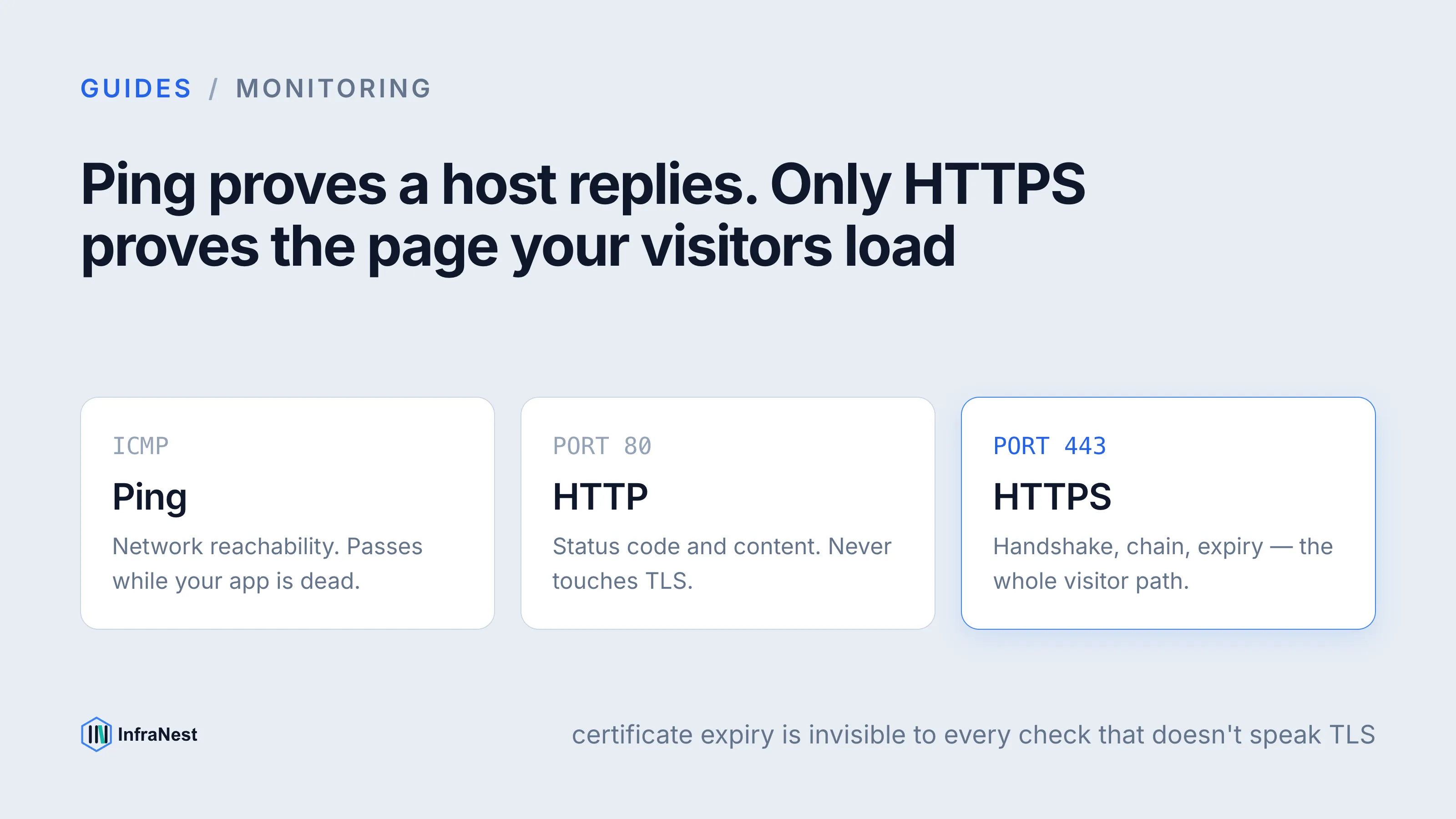
Ping only proves a server responds to network traffic — it says nothing about whether your website, API, or certificate actually works. HTTP monitoring proves your application returns the right response. HTTPS monitoring proves that response is also encrypted with a valid, unexpired certificate. If you're only running ping checks, you have a false sense of security about what "up" means.
What a ping check actually proves
Ping sends an ICMP (Internet Control Message Protocol) Echo Request and waits for an Echo Reply, per RFC 792. A reply confirms one thing: the host is reachable at the network layer (Layer 3) and responded to that specific packet type.
That's it. Ping doesn't know your web server is running, doesn't know your database is up, and can't see whether port 443 is even open. RFC 1122 says hosts should implement an ICMP echo responder — but "should" isn't "must," and plenty of firewalls and cloud security groups deny inbound ICMP by default. That means:
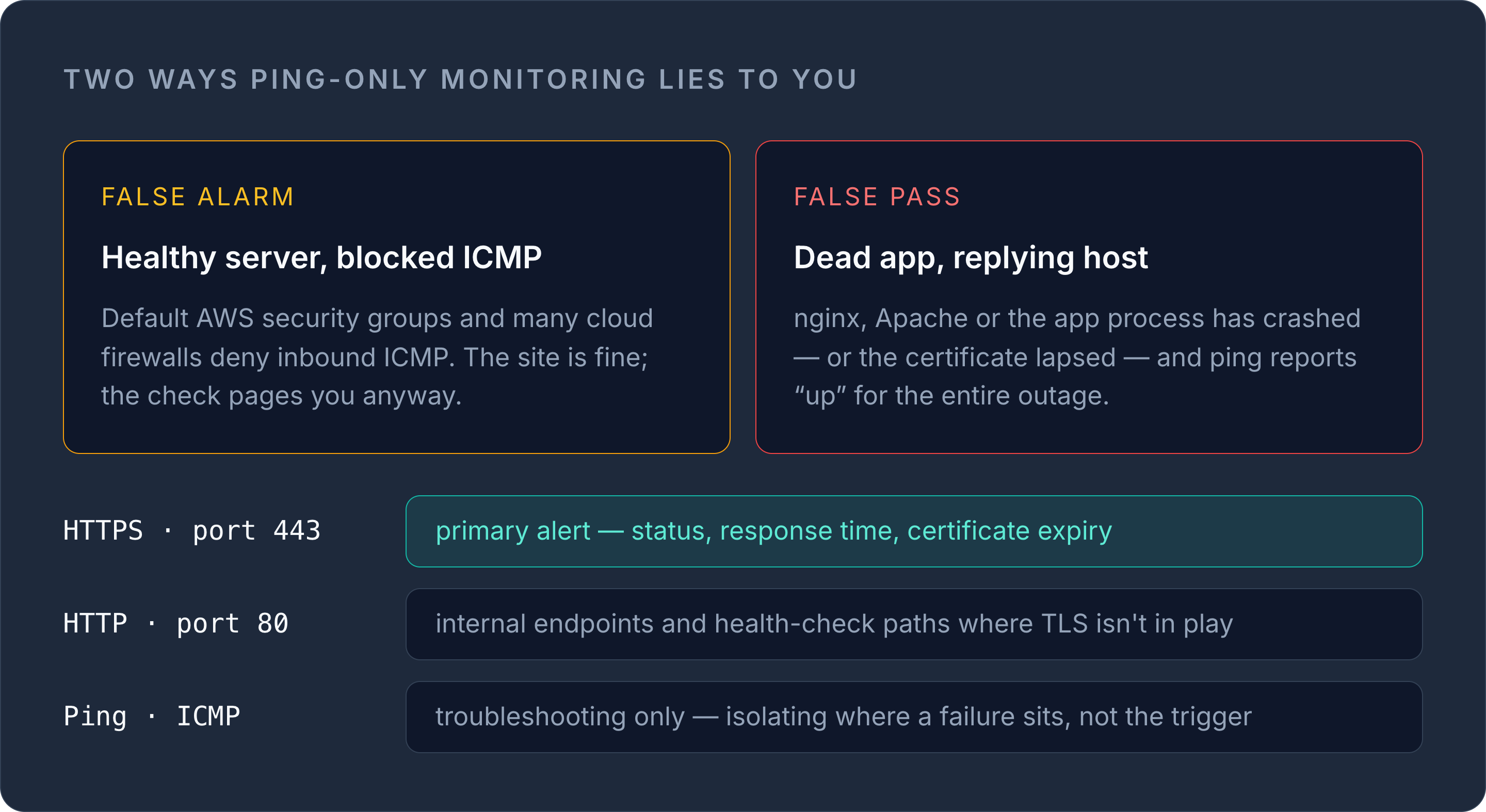
- A perfectly healthy web server can fail a ping check because the network layer blocks ICMP, giving you a false alarm.
- A server can pass a ping check while Apache, nginx, or your app process has crashed entirely — a false pass.
Both failure modes make ping a weak signal on its own. It's useful for basic network reachability during infrastructure debugging, but it was never designed to validate an application.
WarningDefault AWS security groups (and many other cloud firewalls) block inbound ICMP unless you explicitly open it. If you rely on ping-only monitoring in the cloud, you may be monitoring nothing.
What an HTTP check actually proves
An HTTP monitor sends a real request — usually GET or HEAD — to port 80 and inspects the response, following the semantics in RFC 9110 and the message syntax in RFC 9112. A typical check asserts:
- The connection completes and a response is returned within a timeout window.
- The status code falls in the expected range (usually 2xx, sometimes with 3xx redirects allowed).
- Optionally, the response body contains an expected keyword or string.
This proves your web server process is alive and serving the expected content — a real step up from ping. But HTTP monitoring stops at the application layer over plain text. It doesn't touch TLS (Transport Layer Security) at all, so it tells you nothing about whether your HTTPS endpoint — the one your visitors and browsers actually use — is functioning.
A site can return 200 OK on port 80 while its HTTPS listener on port 443 is completely broken due to an expired or misconfigured certificate. An HTTP-only monitor will report "up" the whole time.
What an HTTPS check actually proves
HTTPS monitoring does everything an HTTP check does, plus it validates the TLS layer defined by RFC 8446 (TLS 1.3) and formalised as HTTP-over-TLS by RFC 2818. A proper HTTPS check confirms:
- The TLS handshake completes successfully.
- The certificate chain validates against a trusted root, per the X.509 format in RFC 5280.
- The certificate hasn't expired (and ideally warns you days in advance).
- A modern, non-deprecated protocol version is negotiated — TLS 1.0 and 1.1 were formally deprecated by RFC 8996, so a handshake falling back to them is itself a red flag.
This is the only check type that catches the single most common cause of unexpected "site down" incidents that isn't actually a server crash: certificate expiry. A ping check won't see it. An HTTP-only check on port 80 won't see it. Only a check that speaks TLS to port 443 will.
Comparison at a glance
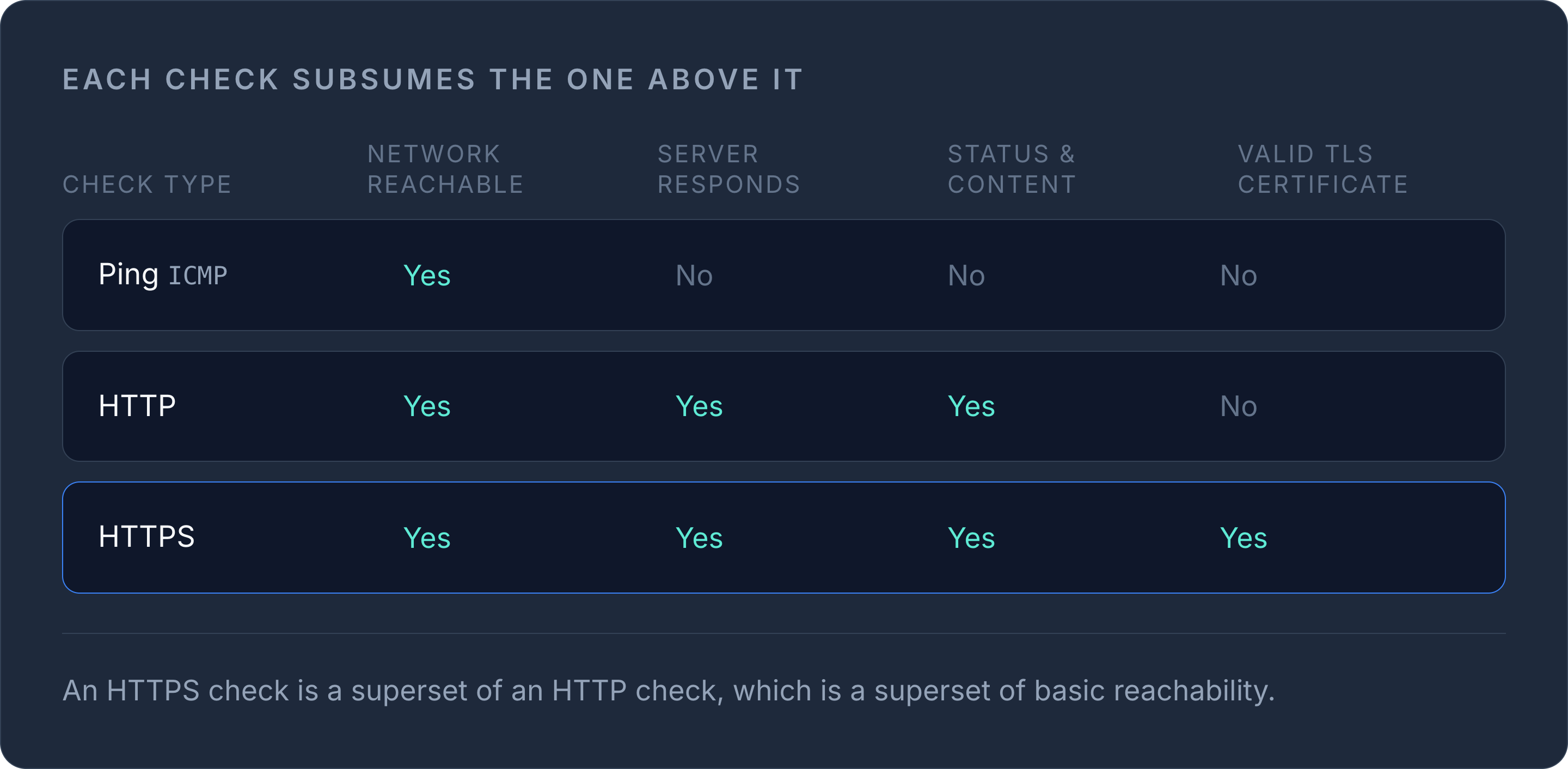
| Check type | Confirms network reachable | Confirms app/server responds | Confirms correct status/content | Confirms valid, unexpired TLS cert |
|---|---|---|---|---|
| Ping (ICMP) | Yes | No | No | No |
| HTTP | Yes | Yes | Yes | No |
| HTTPS | Yes | Yes | Yes | Yes |
Each layer down the table subsumes the one above it — an HTTPS check is effectively a superset of an HTTP check, which is a superset of basic reachability.
Why ping isn't enough on its own
Ping was designed in 1981 for network diagnostics, not for validating modern web applications wrapped in TLS. Relying on it as your primary uptime signal leaves two dangerous gaps:
- False positives from ICMP being blocked at a firewall, security group, or CDN edge, triggering alerts for servers that are actually fine.
- False negatives — the far more damaging case — where the network layer is fine but your app, database connection, or certificate has failed, and ping happily reports "up" the entire outage.
If you want to know a server exists on the network, ping is fine. If you want to know your customers can actually load your site securely, you need HTTP and HTTPS checks running together — plus a certificate-expiry warning that fires well before the cert lapses.
Which check should you actually run?
In practice, most teams should run HTTPS monitoring as the primary check for anything customer-facing, since it validates the full stack a visitor experiences: DNS resolution, TCP connection, TLS handshake, HTTP response, and content. Ping and plain HTTP checks are still worth keeping as secondary diagnostics — they help you isolate where a failure is happening once HTTPS monitoring flags an incident.
A sensible setup looks like this:
- HTTPS check on your public endpoint, asserting status code, response time, and certificate expiry — your primary alert.
- HTTP check on an internal or non-TLS endpoint (health-check paths, internal APIs) where TLS isn't in play.
- Ping/port checks for infrastructure-level reachability during troubleshooting, not as your main alert trigger.
If you're not sure whether a site is currently reachable at all, run it through our free is it down checker for an instant HTTP/HTTPS status check from outside your own network — a good first step before digging into logs.
Setting this up properly
Running ping, HTTP, and HTTPS checks as separate, correctly-configured monitors — each with its own alert thresholds and certificate-expiry warnings — is exactly what dedicated uptime monitoring is for. For a broader walkthrough of how uptime, performance, and SSL checks fit together, see our guide on website monitoring explained.
Set up layered checks — ping, HTTP, and HTTPS with certificate-expiry alerts — across every provider from one dashboard with InfraNest monitoring.
Frequently asked questions
#Is HTTPS monitoring always better than HTTP monitoring?
For any endpoint your visitors reach over HTTPS, yes — an HTTPS check validates the TLS handshake and certificate expiry that an HTTP-only check simply cannot see. Keep HTTP checks for internal or non-TLS endpoints where certificates aren't in play.
#Why does my ping check show a server as down when the website is working fine?
Most cloud firewalls and security groups block inbound ICMP by default, so the server never replies to ping even though its web server on port 80/443 is healthy. This is a classic false positive — the fix is to monitor HTTP/HTTPS instead of, or alongside, ICMP.
#Can an HTTP check on port 80 catch an expired SSL certificate?
No. An HTTP check on port 80 never touches TLS, so it cannot detect certificate expiry, weak ciphers, or handshake failures on port 443 — only an HTTPS check will catch those.
#How far in advance should I be warned about certificate expiry?
Most monitoring providers let you configure a lead time for expiry warnings, commonly somewhere in the range of a few days to a few weeks before expiry; check your provider's current settings and set it generously enough to renew before the certificate lapses.
Was this article helpful?